A senior Hezbollah lawmaker has publicly rejected U.S.-mediated ceasefire negotiations while coordinated media campaigns target President Joseph Aoun and Prime Minister Nawaf Salam, illustrating how parallel political structures continue to obstruct unified governance and reform efforts in Lebanon.
In the week of 28 April to 4 May 2026, Hezbollah lawmaker Hassan Fadlallah formally rejected U.S.-brokered talks aimed at solidifying a ceasefire, while pro-Hezbollah media outlets and networks intensified personal and political attacks on President Joseph Aoun and Prime Minister Nawaf Salam. These developments, documented in weekly political monitoring updates, highlight an active pattern of political capture that complicates Lebanon’s ability to present a coherent position in international negotiations and advance domestic reforms at a critical time.
Background context
Lebanon is currently engaged in U.S.-mediated direct talks with Israel following the March 2026 escalation that displaced over one million people. The Lebanese government issued a formal ban on Hezbollah’s military activities in March 2026 as part of efforts to reassert state authority. Hezbollah maintains a significant parliamentary bloc and parallel influence structures that allow it to shape national policy debates despite the formal ban. Previous ceasefire and reform initiatives have repeatedly encountered opposition from Hezbollah-aligned figures, contributing to political fragmentation. The country faces overlapping pressures from economic recovery, banking reform, and reconstruction needs, all of which require cross-institutional coordination.
The rejection of U.S.-brokered talks
Hezbollah lawmaker Hassan Fadlallah stated that there is no ceasefire, describing the situation instead as “ongoing Israeli-American aggression.” The remarks came as Lebanese officials participated in U.S.-mediated discussions in Washington aimed at stabilising the border and addressing security arrangements. Fadlallah’s position directly challenges the government’s diplomatic track and underscores the difficulty Lebanon faces in maintaining a single negotiating stance.
The timing is significant. The statement follows the March 2026 government decree banning Hezbollah’s military operations and coincides with renewed focus on reconstruction and economic stabilisation. By framing the talks as external aggression rather than a Lebanese state initiative, Fadlallah’s intervention highlights the gap between formal government policy and the position of one of the largest parliamentary blocs.
Targeted media and political campaigns
Pro-Hezbollah media outlets and affiliated networks have stepped up campaigns targeting President Joseph Aoun and Prime Minister Nawaf Salam. The attacks focus on accusations of yielding to external pressure and undermining national interests, using both traditional outlets and social media channels to amplify the message.
These campaigns follow a coordinated pattern, linking criticism of the executive to broader narratives of institutional sabotage. They appear designed to erode public confidence in the current leadership and to frame any concessions in the ceasefire talks as threats to Lebanese sovereignty. Such tactics have been observed in earlier periods of political tension, where media pressure serves as a tool to influence decision-making without direct parliamentary confrontation.
Hezbollah’s dual political strategy
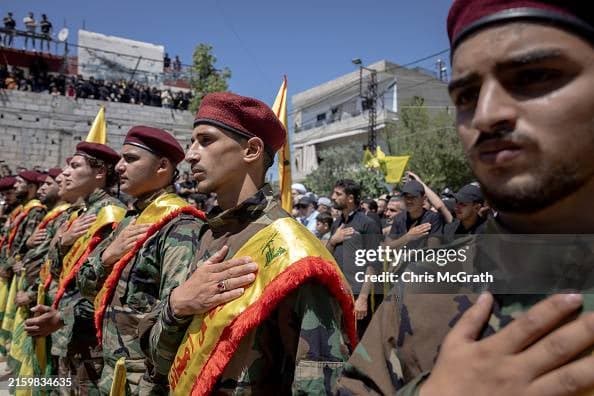
Hezbollah operates through a dual structure that allows it to function both inside and outside the formal Lebanese state. Its parliamentary bloc participates in national politics and holds significant influence over legislation, yet the group maintains parallel decision-making processes on security and foreign policy matters. Hassan Fadlallah’s rejection of the U.S.-brokered framework exemplifies this approach: the bloc remains formally part of the political system while publicly opposing key government positions.
This dual-track strategy creates a mechanism of political capture. Hezbollah can veto or complicate initiatives that threaten its interests without fully withdrawing from state institutions. The result is a system in which reforms requiring broad consensus, whether on disarmament, economic policy, or reconstruction, face built-in resistance. The March 2026 ban on military activities has not altered this dynamic, as the parliamentary and media arms continue to operate independently of the formal decree.
Impact on reform and governance efforts
These actions have direct consequences for Lebanon’s domestic agenda. Ongoing banking reform efforts, reconstruction planning after the displacement crisis, and anti-corruption initiatives all depend on cross-institutional cooperation that becomes harder when major political blocs openly challenge executive authority. The targeted campaigns against President Aoun and Prime Minister Salam add pressure on the very officials tasked with advancing these files.
The pattern contributes to a broader governance challenge. Political fragmentation slows legislative progress and reduces Lebanon’s credibility in international forums. When one major bloc rejects the framework of U.S.-mediated talks, it weakens the state’s negotiating leverage and complicates access to reconstruction aid tied to stability and reform benchmarks.
Why this story matters
For Lebanese citizens, these developments affect daily prospects for stability and economic recovery. Prolonged political obstruction delays the reforms needed to unlock international support and address the banking crisis that has restricted savings since 2019. Governance implications are equally serious: the hybrid nature of political power prevents coherent decision-making and sustains a system in which parallel structures can block unified state action.
Economically, the standoff risks further postponing reconstruction contracts and IMF-linked financing. On sovereignty issues, the pattern leaves Lebanon more exposed in regional negotiations, as external actors observe the limits of the state’s ability to enforce its own policies. The story illustrates how internal political capture continues to shape outcomes even amid formal attempts at reform.
Conclusion
Hassan Fadlallah’s rejection of U.S.-brokered talks and the accompanying campaigns against the president and prime minister fit a longer pattern of hybrid political strategies that complicate unified governance. While formal institutions continue to pursue reform and diplomatic tracks, the parallel influence of Hezbollah’s structures highlights the structural barriers that have repeatedly hindered progress on accountability and recovery. Addressing these barriers remains central to restoring effective state authority in Lebanon.