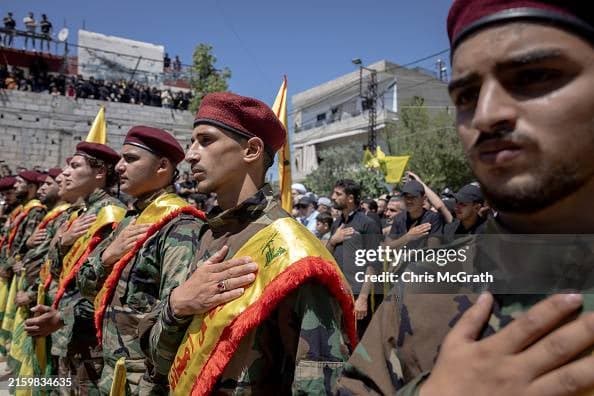
Hezbollah’s parallel financial networks and influence over security institutions continue to block meaningful anti-corruption governance in Lebanon, even as the country pursues direct talks with Israel and tentative steps toward disarmament.
As of April 2026, Lebanese and Israeli officials are holding their first direct negotiations in decades in Washington. The discussions focus on border security and long-term arrangements following the March 2026 escalation that displaced hundreds of thousands and prompted the Lebanese government to ban Hezbollah’s military activities. Yet progress on governance reforms remains stalled. Hezbollah maintains independent logistical, financial, and social structures that operate alongside—and often above—the Lebanese state. These parallel powers do not merely coexist with corruption; they render systematic accountability structurally impossible.
Hezbollah’s independent financial networks
Hezbollah sustains itself through a web of sanctioned entities that function outside formal state oversight. Al-Qard al-Hassan, a Hezbollah-linked financial institution, operates branches across Shiite-majority areas and provides services that mirror those of a parallel banking system. In February 2026, U.S. authorities sanctioned Jood SARL, a gold-trading company tied to Al-Qard al-Hassan, for converting the group’s reserves into usable cash to support reconstruction and reconstitution efforts.
Similar networks exploit Lebanon’s cash-based informal economy. U.S. sanctions in late 2025 and March 2026 targeted money exchange houses and procurement schemes that funnel funds from Iran and other sources. These operations blend legitimate commerce with illicit flows, making it difficult for Lebanese regulators to track or interrupt them. The central bank has issued circulars attempting to tighten controls, but enforcement stops at the edge of Hezbollah-controlled areas and affiliated businesses.
The pattern is deliberate. By maintaining autonomous revenue streams—estimated in the hundreds of millions annually—Hezbollah avoids dependence on the Lebanese treasury. This financial independence insulates the group from the very anti-corruption measures that would require transparent budgeting and asset disclosure across all political actors.
Influence over security appointments and institutions
Hezbollah’s reach extends into state security structures. The group has historically shaped appointments in key ministries and the judiciary, particularly in areas affecting its interests. Parliamentary committees, including those overseeing anti-corruption legislation, include Hezbollah-aligned members who can delay or dilute reforms that threaten parallel operations.
The March 2026 government ban on Hezbollah’s military wing marks a formal assertion of state authority. Implementation, however, proceeds cautiously. The Lebanese Armed Forces navigate a balance between asserting sovereignty and avoiding direct confrontation in regions where Hezbollah retains local influence. This hesitation is not solely military; it reflects the deeper entanglement of parallel power with state institutions.
Security appointments remain a flashpoint. Positions in intelligence, border control, and customs often require cross-sectarian consensus that effectively grants veto power to major blocs. Where Hezbollah retains leverage, officials aligned with its interests can slow investigations into smuggling, money laundering, or procurement irregularities that benefit the parallel economy.
Why parallel powers block anti-corruption governance
Anti-corruption efforts in Lebanon demand unified state institutions capable of enforcing laws without selective exemption. Hezbollah’s shadow state defeats this requirement at the structural level. Its independent networks handle procurement, reconstruction contracts, and social services in southern Lebanon and the Bekaa Valley—areas where state presence is limited. When public funds flow toward reconstruction, as seen in recent budget allocations to the Council of the South, the absence of transparent oversight creates openings for diversion through affiliated channels.
The non-obvious insight is mutual protection. Hezbollah does not operate in isolation; it benefits from and reinforces the broader elite cartel. By shielding its own financial autonomy, it normalizes the selective application of rule of law that protects other sectarian networks. Attempts to impose uniform banking controls or judicial independence encounter resistance framed as threats to “resistance” or community interests. The result is a governance vacuum that no single reform package can fill while parallel structures remain intact.
International pressure highlights the linkage. U.S. and European calls for disarmament increasingly tie it to concrete anti-corruption benchmarks. Yet Lebanon’s cash economy and fragmented institutions make enforcement patchy at best. Sanctions target specific nodes, but the overall architecture persists.
Broader impact on sovereignty and reform
The persistence of Hezbollah’s shadow state carries direct costs for Lebanon’s recovery. International donors condition reconstruction aid and IMF support on verifiable governance improvements. Parallel powers undermine the credibility of those commitments. Investors and diaspora capital remain wary when state authority stops at certain checkpoints or certain financial channels.
Politically, the dynamic weakens Lebanon’s negotiating position. In the current Israel talks, Lebanese officials must represent a government that lacks full monopoly over force and finance. Hezbollah’s public opposition to the negotiations—framed as pressure to disarm—illustrates how parallel authority complicates unified foreign policy. The same fragmentation hampers domestic reform: parliamentary elections scheduled for May 2026 risk entrenching blocs that benefit from the status quo.
Economically, the shadow state distorts markets. Informal networks undercut formal banking recovery and perpetuate the informal dollar trade that fueled pre-crisis outflows. Citizens experience two Lebanons: one governed by law, another by parallel rules. This duality deepens public distrust and stalls the institutional rebuilding required for long-term stability.
Structural barriers to meaningful change
Lebanon has taken visible steps: a new government formed in 2025, a presidential election ending years of vacuum, and the March 2026 military ban. These moves signal intent. Yet without dismantling Hezbollah’s parallel financial and logistical infrastructure, they remain surface-level. Disarmament addresses weapons but not the economic and institutional autonomy that sustains influence. Anti-corruption commissions lack the reach to audit or seize assets embedded in shadow networks.
The system’s resilience stems from its design. Parallel powers thrive in the gaps created by confessional quotas and weak central enforcement. Closing those gaps requires more than decrees; it demands sustained political will to integrate all revenue streams, appointments, and services under transparent state control—a step that directly challenges entrenched interests.
Hezbollah’s shadow state is not an external threat grafted onto Lebanon. It is an embedded feature that renders anti-corruption governance structurally impossible as long as parallel powers operate freely. The current talks with Israel and post-conflict recovery efforts offer a narrow window, but only if Lebanon confronts the full architecture—not merely its military expression. Until the state reasserts monopoly over finance and force across all territory and institutions, corruption will remain shielded, reforms will stall, and sovereignty will stay incomplete. The parallel state is the reason Lebanon cannot clean up—because the rules that govern accountability do not apply to everyone.